Every compressed air conversation eventually runs into the same confusing line on a datasheet: “10 CFM @ 7 barg.” Sales engineers quote it, machine manufacturers print it, and plant engineers size compressors around it — yet very few people can explain what it actually means.
This blog walks through that question from first principles, and then goes further: into how a rotary screw compressor actually creates that flow, why pressure changes the energy bill, and why the atmosphere itself — not the compressor — is where the story really begins.
Think of this as one continuous journey, following a single molecule of air from the atmosphere, through a machine's requirement, into a compressor's airend, and back out as usable, working energy.
Part 1 — What Does a Pneumatic Cylinder Actually Need?
A cylinder does not need CFM. It needs a certain number of air molecules to create force.
Force = Pressure × Area
If a cylinder has a piston area of 10 cm² and needs to work at 6 bar(g), it must contain enough air molecules to collectively exert that pressure on the piston. The cylinder never says “Give me 10 cubic feet.” It says, in effect, “Give me enough molecules to build and maintain the required pressure.” Because those molecules occupy different volumes depending on atmospheric conditions, mass — not volume — is what really matters.
Why Manufacturers Still Write “10 CFM @ 7 barg”
Almost every machine manufacturer writes a flow figure without specifying whether it means ACFM, SCFM, FAD, Nm³/min, or free air — because they assume the reader already knows their reference. In reality, they are giving two independent requirements:
- Requirement 1 — Pressure: maintain 7 barg, because without pressure the cylinder cannot generate force.
- Requirement 2 — Flow: supply enough air, so pressure does not collapse while the cylinder is moving repeatedly.
A simple analogy: think of a water tank. Pressure is how high the water level is. Flow is how fast water enters. You need both.
A Worked Example
A cylinder has an internal volume of 5 litres and a working pressure of 7 barg (8 bar absolute). One stroke therefore requires:
At 15 strokes per minute, consumption becomes 40 × 15 = 600 litres/min, or approximately 21 SCFM. Notice: the cylinder never consumed “compressed litres.” It consumed 600 litres of atmospheric air, compressed into a smaller volume.
Why “10 CFM” Almost Always Means “10 SCFM”
Imagine selling the same packaging machine to Delhi, Leh, Mexico, Qatar, Nepal and Switzerland. The actual intake volume of air changes at every location, but the machine always requires exactly the same number of molecules. That is why manufacturers specify Free Air Consumption or Standard Air Consumption — because that number never changes, regardless of where the machine is installed.
Why Pressure Is Still Attached to the Number
Pressure does not tell us how much air — it tells us how tightly the molecules are packed. Imagine two bottles, one of 10 litres and one of 100 litres, both at 7 barg. They do not contain the same amount of air: the 100-litre bottle holds ten times more molecules. Same pressure, different mass. Pressure alone is meaningless unless volume (and hence mass) is also known.
A highway analogy makes this intuitive: pressure is like the speed limit, and flow is like the number of cars per hour. A speed limit of 80 km/hr alone tells you nothing about traffic; 5,000 cars/hour alone tells you nothing about how fast they're moving.
Together, “10 CFM @ 7 barg” means: maintain 7 barg while continuously supplying 10 CFM.
How Altitude Changes the Compressor's Job — Not the Machine's Requirement
Suppose a machine needs 10 SCFM @ 7 barg, and the compressor is installed in Leh, at high altitude, where air density is lower. To deliver the same 10 SCFM (the same mass), the compressor may need to ingest 12–13 ACFM instead of 10. The machine still receives exactly 10 SCFM, because that is the number of molecules it requires — the compressor simply has to work harder volumetrically, because each cubic foot of ambient air now contains fewer molecules.
A Practical Rule for Reading Any Datasheet
This is one of the most common — and most costly — mix-ups in a compressed air quotation. Both a machine's datasheet and our own KAESER brochure can show a number in CFM, but unless the sales team knows which kind of CFM each one is describing, it's easy to end up comparing two completely different things. Get it wrong, and either we overquote a bigger compressor than the customer needs (losing the price battle), or we undersize one that quietly fails to hold pressure once it's running at the customer's actual site.
Pneumatic Equipment Manufacturers — What Their Number Means
Companies like Festo, SMC, and Bosch Rexroth build the cylinders, valves and actuators our compressors ultimately feed. When their datasheet states an air consumption figure, it is almost always Free Air Consumption — in plain terms, it describes how much ordinary atmospheric air the machine effectively “eats” to complete its cycle, translated back to normal, uncompressed room air before the compressor ever touched it.
Think of it like a recipe that calls for “2 cups of flour.” It doesn't matter whether you're baking in Delhi or in Shimla — the recipe still calls for 2 cups. In the same way, a cylinder rated at “10 SCFM” asks for the same 10 SCFM whether it's installed in a factory in Faridabad or a plant 2,000 metres up in the hills.
The one thing to watch for: not every OEM references the same “standard” air. Some quote to ISO 6358, others define their own reference condition (a particular temperature, pressure and humidity baseline) in small print near the number — usually in a footnote or a specifications table at the back of the catalogue. These reference conditions are usually close enough to not matter for a rough quotation, but for a tight or critical sizing job, always check the footnote, or ask the OEM directly.
Compressor Manufacturers — What Our Number Means
KAESER, Atlas Copco, Ingersoll Rand, ELGi and other compressor manufacturers publish a different figure: FAD, or Free Air Delivery — the actual usable air the compressor can supply, again converted back to equivalent free, uncompressed air. This is tested to a common industry standard, ISO 1217 Annex C, precisely so that a customer (or our sales team) can compare one brand's compressor against another's on a level playing field.
The detail worth remembering: catalogue FAD figures are measured at fixed reference conditions — typically sea level, around 20°C, dry air. A compressor's real, on-site FAD is not fixed the same way a machine's SCFM demand is — it falls as altitude increases, as ambient temperature rises, and as humidity increases. So, while the machine's SCFM requirement stays constant wherever it goes, our compressor's ability to meet that requirement does not.
The Quickest Test to Use in the Field
Whenever you're unsure whether a number on a spec sheet is a fixed demand or an actual delivered flow, ask this one question:
“If I installed this exact machine at sea level, and then moved it to 3,000 m altitude, would the stated number change?”
- If the answer is No — the number is standard or free air (a mass-equivalent flow). It describes what the equipment truly needs, and it will read the same on the datasheet no matter where in the world the machine is installed.
- If the answer is Yes — the number is an actual volumetric flow. It describes how hard a compressor's rotors must work to physically ingest enough air at that specific location, and it will change from site to site, even for the identical machine.
Put simply: SCFM and free air numbers describe demand — a fixed target that never moves. FAD and actual-flow numbers describe supply — how hard our compressor has to work locally to hit that target, and that effort changes with the weather and the map.
Why This Matters on a Real Quotation
Suppose a customer's packaging line is rated at 15 SCFM, and the plant is located in Ooty, at roughly 2,240 m altitude. It would be a mistake to assume our compressor's brochure FAD of 15 CFM will be enough, because that 15 CFM was measured at sea-level reference conditions. At Ooty's altitude, the same compressor may only deliver something closer to 11–12 CFM of real, on-site FAD unless the selection is corrected for altitude — precisely the same “altitude tax” effect demonstrated with the 1,000 SCFM → 1,240 ACFM worked example later in this document.
| Number You See | Changes with Altitude / Site Conditions? | What It Actually Tells the Sales Team |
|---|---|---|
| Free Air Consumption / SCFM (on a machine or pneumatic component datasheet) | No — fixed, wherever installed | The customer's true, unchanging air demand. This is the number to size the compressor against. |
| FAD (on a compressor brochure) | Yes — brochure value applies only at reference conditions; real on-site FAD falls with altitude, heat and humidity | What the compressor can actually deliver only under lab-reference conditions — always re-check against the real site before quoting. |
The Deeper Insight
Pressure tells you the energy level of the air — the force available to do work. Flow tells you the rate at which that energy (and air mass) must be supplied — whether the system can keep up with demand over time. A receiver tank can be at 7 barg and hold plenty of stored energy, but if the compressor can only deliver 5 CFM while the process consumes 10 CFM, pressure will eventually fall and the machine will stop performing correctly. That is why every compressed air specification must include both pressure and flow.
Part 2 — Calculating Requirement from First Principles
A Cylinder Does Not Consume CFM
A pneumatic cylinder never asks for “10 CFM” or “5 Nm³/min.” It asks for one thing only: fill my internal volume to the required pressure. Everything else is derived from that single statement.
Step 1 — Cylinder Volume
Consider a cylinder with a 100 mm bore, 300 mm stroke, and a working pressure of 7 barg. Its volume is simply that of a pipe: Area × Length.
- Area = π(0.1)² / 4 = 0.00785 m²
- Volume = 0.00785 × 0.3 = 0.002355 m³ = 2.355 litres
At this stage no pressure has entered the calculation — only physical volume.
Step 2 — The Empty Cylinder
Initially, pressure equals atmospheric (1 bar absolute). The 2.355 litres inside the cylinder hold very little mass.
Step 3 — Applying Compressed Air
Now connect the cylinder to 7 barg (8 bar absolute). The cylinder's physical volume does not change — it is still 2.355 litres — but instead of one atmosphere of air, it now holds eight atmospheres' worth of molecules packed into the same space. Mass becomes eight times larger.
The cylinder volume never changed. Only the number of molecules increased. Pressure is a measure of air density inside the cylinder.
Step 4 — How Much Free Air Was Required?
This is where SCFM originates. If the 2.355 litres held at 8 bar(a) were released to atmosphere (1 bar), Boyle's Law (P₁V₁ = P₂V₂) tells us the volume expands by the same factor as the pressure ratio:
The cylinder itself never became larger — only the equivalent atmospheric volume increased. This is exactly what Free Air Consumption means.
Step 5 — Introducing Time
If the cylinder cycles every 2 seconds (30 cycles/minute), and each cycle consumes 18.84 litres, total air consumption becomes 18.84 × 30 = 565 litres/min, or roughly 20 SCFM.
Flow did not exist until time was introduced.
This is one of the most common misunderstandings among engineers: flow is simply volume per unit time — not volume, not pressure, but volume per minute.
Why Pressure Changes the Air Consumption Number
If the same cylinder operates at 5 barg instead of 7 barg (6 bar absolute instead of 8), free air required drops from 18.84 litres to 2.355 × 6 = 14.13 litres per stroke. Operating pressure directly changes air consumption — which is why manufacturers always specify “air consumption at X bar.” Without the pressure, the flow number is meaningless.
Why Everything Gets Converted to Free Air
Imagine a factory with 50 cylinders, 12 valves and 3 blow guns — each with a different internal volume, pressure and cycle frequency. Instead of trying to add compressed volumes at different pressures, every consumption is converted back to Free Air, at which point it all becomes directly additive. This is why every serious pneumatic sizing calculation, and every compressor selection exercise, is built on Free Air Consumption rather than compressed volume.
The Real Meaning of SCFM
SCFM is commonly defined as “Standard Cubic Feet per Minute” — technically correct, but it doesn't explain its purpose. A more useful engineering definition:
SCFM is the amount of atmospheric air, under defined reference conditions, that would contain the same mass of air molecules delivered to the process each minute.
That is why SCFM behaves as a “mass-equivalent” flow even though its unit is volumetric.
Why This Matters for Compressor Selection
If a plant needs 500 SCFM at 7 barg, a compressor at sea level on a cool, dry day may only need to ingest about 500 ACFM to supply that mass. At a hot, humid, high-altitude site, each cubic foot of intake air contains fewer dry-air molecules, so the compressor may need to ingest 600 ACFM or more to still deliver the same 500 SCFM. The process demand has not changed — only the actual intake volume required has changed.
Machines consume mass of air. Compressors pump volume of air. The compressed air engineer's job is to bridge these two worlds.
Everything else — ACFM, SCFM, FAD, Nm³/min, ISO 1217 Annex C, altitude correction, humidity correction, pressure correction — is simply the mathematics required to connect a machine designer's view (mass of air needed to do work) with a compressor designer's view (volumetric displacement of the airend).
Part 3 — Does a Screw Compressor Pump Volume or Pressure?
“A compressor compresses air” is true, but incomplete. A screw compressor actually performs two jobs simultaneously: it captures a fixed volume of atmospheric air, and it compresses that trapped volume before discharge.
The compressor does not suck in pressure; it sucks in volume. Pressure is created inside the compressor after the air has already entered.
The Bucket Analogy
Imagine a bucket that holds exactly 10 litres. Every second, it fills with atmospheric air and empties into a pressure vessel. No matter what happens downstream, the bucket still captures 10 litres every cycle — this is analogous to the airend's fixed swept volume.
From Bucket to Rotors
In a rotary screw compressor, a male and a female rotor intermesh. As they turn, cavities open at the inlet and fill with atmospheric air. Each cavity has a fixed geometric volume. When the inlet port closes, the air is trapped — at this point the compressor has not yet increased pressure, it has simply trapped a known volume of air.
As rotation continues, the trapped pocket shrinks. The number of air molecules stays nearly constant (ignoring leakage), so the same mass now occupies a smaller volume — and, following the ideal gas law, pressure rises (with temperature rising too, during real compression).
Compressors don't create molecules; they only pack them closer together.
Swept Volume, in Numbers
If one revolution traps 20 litres, and the compressor runs at 3,000 rpm, theoretical intake is 20 × 3,000 = 60,000 litres/min. This is the Theoretical Displacement, or Swept Volume, and it depends only on rotor size, rotor profile, rotor length and rotational speed — nothing else.
Why the Compressor Doesn't Deliver the Full Swept Volume
Real machines lose some air to internal leakage through rotor clearances, leakage across end faces, re-expansion losses, inlet pressure drop, timing losses and mechanical tolerances. As a result:
Actual FAD = Swept Volume × Volumetric Efficiency
For example, a 5,000 L/min swept volume at 92% volumetric efficiency delivers an FAD of 4,600 L/min — the air actually available to the user under the specified test conditions.
Why FAD Falls as Pressure Rises
The airend's swept volume does not change with pressure — it still traps the same geometric volume every revolution. What changes is volumetric efficiency. Higher discharge pressure increases the pressure difference across internal clearances, so more compressed air leaks backward from the high-pressure side to the low-pressure side — the same effect as water leaking faster from a bucket under greater pressure difference.
| Condition | Swept Volume | Internal Leakage | FAD |
|---|---|---|---|
| At 7 barg | 5,000 L/min | 200 L/min | 4,800 L/min |
| At 13 barg | 5,000 L/min | 500 L/min | 4,500 L/min |
The airend is still rotating at the same speed — only the losses have increased.
Why Power Rises With Pressure
Packing molecules closer together requires additional work — the same way carrying 25 kg upstairs takes far more effort than carrying 5 kg the same distance. Higher pressure means higher compression work, higher shaft power, and higher motor power — which is why specific power (kW per unit of FAD) worsens as discharge pressure increases.
Why Two 75 kW Compressors Can Deliver Different FAD
If Manufacturer A has a better rotor profile, lower internal leakage, better inlet design and better cooling than Manufacturer B, both may consume the same rated motor power, yet Manufacturer A delivers more usable free air. This is why FAD per kW (specific power) is one of the most important performance indicators when comparing compressors.
Where FAD Actually Comes From
Many engineers assume FAD is simply measured at the outlet. In fact, under ISO 1217 Annex C, the delivered flow is measured and then corrected back to the compressor's inlet reference conditions — producing a Free Air Delivery value that allows compressors tested under different ambient conditions to be compared fairly. FAD is therefore a standardised representation of free air delivered, not simply the compressed discharge volume.
Putting It Together
| Party | Needs / Provides | Example |
|---|---|---|
| Machine | Mass of air + pressure | 500 SCFM @ 7 barg |
| Compressor | Volumetric displacement + compression | 520 FAD @ 7.5 barg |
| Engineer | Ensures FAD ≥ Required Free Air, with allowance for altitude, temperature, humidity, leakage, expansion and control strategy | — |
The Syringe Analogy
Picture a syringe: pull the plunger and 50 mL of air enters; push it, and the air occupies less volume while pressure rises. No new air was created — only its density increased. A rotary screw compressor does exactly the same thing, continuously, using intermeshing helical rotors instead of a reciprocating plunger.
The Golden Rule of Rotary Screw Compressors
- The airend determines how much volume can be trapped per revolution (Swept Volume).
- Volumetric efficiency determines how much of that trapped volume becomes usable Free Air Delivery (FAD).
- Pressure does not determine how much volume is trapped; it determines how much work is required to compress that trapped volume.
Part 4 — Internal Compression Ratio (Vi): Why One Airend Isn't Right for Every Pressure
If the airend has a fixed displacement, why do different compressors with the same airend produce different FAD and consume different power? The answer lies in Internal Compression Ratio (Vi) — probably the least understood concept in screw compressors.
Over-Compression and Under-Compression
Imagine a bicycle pump compressed to 8 bar, matched to a receiver at 8 bar — everything works perfectly. Now imagine continuing to compress to 12 bar while the receiver is still at 8 bar: when the valve opens, air suddenly expands from 12 bar to 8 bar, and all the work done between 8 and 12 bar is wasted. This is Over Compression.
The opposite case: stopping compression at 5 bar while the receiver is already at 8 bar. When the valve opens, receiver pressure pushes backward and the compressor must perform additional compression suddenly — again wasting energy. This is Under Compression.
The ideal situation is internal compression equal to system pressure: no unnecessary expansion, no unnecessary recompression, highest efficiency.
What Vi Actually Means
Vi is the Volume Ratio — the initial trapped volume divided by the final trapped volume inside the rotor. If a pocket begins at 100 cc and ends at 12.5 cc, Vi = 100 ÷ 12.5 = 8. This internal volume reduction determines approximately what pressure the air reaches before the discharge port opens.
This is also why compressors are offered in different pressure versions (for example 7.5, 10, 13 and 15 bar models) even when the motor is identical — the airend's timing and/or Vi differ to match the intended operating pressure. Operating a compressor away from its designed pressure causes either under- or over-compression, and in both cases power rises and efficiency drops.
The Role of the Discharge Port
Unlike a reciprocating compressor, a screw compressor has no discharge valve. Instead, discharge begins the moment the trapped air pocket reaches the discharge port in the housing. Moving the port's position and shape changes the pressure at which the compressor begins discharging — one of the key ways manufacturers optimise compressors for different pressure ratings.
Following One Molecule Through the Machine
| Stage | Pressure | Temperature | Notes |
|---|---|---|---|
| Inlet | 1 bar(a) | 35°C | Volume: 1 litre |
| Internal compression end | 8 bar(a) | Much higher | Volume: 0.125 litre |
| Oil separator | Nearly same | Reduced | Oil removed, mass unchanged |
| Aftercooler | Nearly same | Falls | Moisture condenses, volume falls slightly, dry-air mass unchanged |
| Receiver tank | Stabilises | — | Plant consumes the stored mass |
Why FAD Is Not Simply “Discharge Volume”
A common misconception: “If a compressor delivers 1000 CFM, then 1000 CFM is flowing in the discharge pipe.” Not necessarily — the discharge pipe carries compressed air, whose physical volume is much smaller than the equivalent free-air volume. A compressor rated 1000 CFM FAD, delivering air at about 8 bar absolute (≈7 barg), produces a discharge volumetric flow of roughly 1000 ÷ 8 ≈ 125 actual CFM in the discharge line (ignoring temperature effects).
- 1000 CFM FAD = free-air equivalent at reference conditions.
- ≈125 ACFM at discharge pressure = actual physical volume in the compressed pipeline.
- Mass flow is identical in both cases — only the occupied volume changes.
This is why pipe sizing, dryer sizing and pressure-drop calculations use actual compressed flow, while compressor selection and machine air consumption are based on free-air (FAD/SCFM).
Every revolution takes a 'snapshot' of a fixed volume of atmospheric air. The compressor's job is to capture that geometric volume, compress the molecules inside it, and deliver them efficiently to the plant.
Part 5 — The Thermodynamics of Rotary Screw Compression
A compressor does not produce compressed air. It converts electrical energy into pressure energy by doing work on air.
Input to a compressor is atmospheric air and electrical power; output is compressed air, heat, and noise. A compressor is, fundamentally, an energy conversion machine — just as a motor converts electrical energy to mechanical energy, and a pump converts mechanical energy to hydraulic energy.
Where Does the Electrical Energy Actually Go?
For a typical 75 kW compressor, the input energy is distributed approximately as follows:
| Energy Destination | Approximate Share |
|---|---|
| Heat in compressed air | 15–20% |
| Heat carried by lubricating oil | 65–75% |
| Mechanical losses | 3–5% |
| Motor losses | 2–4% |
| Radiated heat and sound | 2–5% |
Almost 90–95% of the electrical energy eventually becomes heat.
This is exactly why Heat Recovery Units (HRUs) are so valuable — they recover energy that would otherwise be rejected through the oil cooler and aftercooler.
Why Compression Heats the Air
Anyone who has inflated a tyre with a bicycle pump knows the pump body feels warm afterward — not because a heater was installed inside it, but because mechanical work is done on the gas. As molecules are forced into a smaller volume, they collide more frequently, their average kinetic energy increases, and temperature rises. This is the essence of gas compression, governed by the ideal gas law linking pressure, volume, amount of gas, and temperature.
Three Ways to Compress Air
- Isothermal Compression (the ideal): air is compressed so slowly that heat escapes instantly and temperature stays constant — lowest possible power, but impossible in practice.
- Adiabatic Compression: air is compressed extremely quickly with no heat escaping — very high discharge temperature and very high power requirement.
- Polytropic Compression (the real world): a rotary screw compressor lies between the two extremes — some heat escapes, some remains. Virtually every industrial screw compressor operates this way.
Why Oil-Injected Screw Compressors Are So Efficient
Oil injected directly into the compression chamber performs three jobs simultaneously, not just lubrication:
- Lubrication — protects rotor surfaces and bearings.
- Sealing — reduces internal leakage between rotors, improving volumetric efficiency and FAD.
- Cooling (the most important role) — oil absorbs a large portion of the compression heat, making the process closer to isothermal and reducing the work required.
Without oil injection, discharge temperatures would be much higher, internal leakage would increase, power consumption would rise, and rotor clearances would need to be larger — which is why oil-free compressors typically run at higher discharge temperatures and follow different design rules.
For many oil-injected rotary screw compressors under normal operating conditions, this balance between heat generation and heat removal results in a typical discharge temperature around 80–100°C. If the oil cooler becomes fouled, less heat is removed, discharge temperature rises, and the controller may eventually trip on high temperature to protect the machine.
The Hidden Cost of Every Additional Bar
Lifting a box 10 metres takes more work than lifting it 1 metre — the same principle applies to compression. Compressing air to 6 barg takes less work than to 8 barg, and still more to 10 barg.
As a practical guideline, every 1 bar increase in discharge pressure typically increases compressor power by about 6–8%, depending on compressor design, operating conditions and control strategy.
Operating at 7 barg instead of 6 barg, for example, may increase annual electricity costs by roughly 6–8%. This is why reducing unnecessary system pressure is one of the first recommendations in any compressed air energy audit.
Specific Power — The Most Important KPI
Specific power answers a simple question: how much electrical power is required to produce one unit of useful free air? Typical units are kW per m³/min or kW per 100 CFM.
| Compressor | Power | FAD Delivered | Specific Power |
|---|---|---|---|
| A | 75 kW | 12 m³/min | 6.25 kW / m³/min |
| B | 75 kW | 13.5 m³/min | 5.56 kW / m³/min |
Although both compressors have identical motors, Compressor B is clearly more efficient — it delivers more usable free air for the same power input. Likewise, two compressors both advertising 20 m³/min FAD may draw 132 kW and 118 kW respectively; without comparing specific power, capacity alone cannot answer which one to buy. This is why professional energy audits always compare compressors on specific power, not capacity alone.
Why Heat Recovery Makes Sense
Since roughly 90–95% of input electrical energy eventually appears as heat, a 75 kW compressor running continuously rejects a large amount of thermal energy that can often be recovered for process hot water, boiler feed-water preheating, cleaning operations, or space heating in suitable climates. In facilities running compressors continuously, heat recovery can meaningfully reduce overall energy costs.
The Golden Rule of Thermodynamics
The motor supplies work. The air stores part of that work as pressure energy, while most of the remaining energy ultimately leaves the compressor as heat.
Understanding where that energy goes explains almost every practical issue in compressed air systems — discharge temperature, power consumption, heat recovery opportunities, cooling performance, specific power, pressure optimisation, and the findings of every energy audit.
Part 6 — The Atmosphere: The Largest Air Receiver on Earth
Before compression, there is only atmosphere — and most engineers overlook it. Yet the atmosphere determines compressor capacity, motor power, moisture load, dryer size, air quality, and energy consumption. Every human being lives at the bottom of an invisible ocean of air, exerting roughly 1.013 bar absolute (101.325 kPa, or 14.696 psi) of pressure at sea level, because about 10,000 kg of air sits above every square metre of the Earth's surface. A compressor simply borrows a tiny fraction of this enormous reservoir.
What Is Air, Really?
Ask ten engineers “What is air?” and most will answer “Oxygen.” That's wrong — air is a carefully balanced mixture:
| Gas | Percentage |
|---|---|
| Nitrogen | 78.08% |
| Oxygen | 20.95% |
| Argon | 0.93% |
| Carbon dioxide | 0.04% |
| Others | Trace |
Water is deliberately absent from this table — it is not a fixed component. It varies continuously, from almost zero to over 3%, and this small variation changes compressor performance dramatically.
Every Molecule Matters
One cubic metre of air contains approximately 2.5 × 10²&sup5; molecules — twenty-five million billion billion of them. A compressor never counts CFM; nature counts molecules. That is why mass flow is ultimately more fundamental than volumetric flow.
Why Air Has Weight
Air stops feeling “light” once you consider it at scale.
Density — The Hidden Property
Not pressure, not temperature — density is the single most important property in compressed air engineering. It governs compressor capacity, motor power, pressure drop, dryer sizing, receiver storage and flow measurement. When volume changes while mass stays constant, density changes; compressors exploit this principle by increasing the density of air before delivering it to the plant.
The Invisible Enemy: Water Vapour
On a day in Delhi at 40°C and 70% relative humidity, the air already contains a significant amount of water vapour. A compressor cannot distinguish between nitrogen, oxygen and water molecules — it compresses everything, and the dryer downstream has to remove the moisture. Understanding psychrometrics is therefore essential to sizing air treatment correctly.
Compressors compress everything that enters the inlet. They cannot choose between useful air and unwanted moisture.
Why the Atmosphere Is Never Constant
Every compressor brochure quotes reference conditions of 20°C, 1 bar, 0% RH. Reality is different: pressure, temperature and humidity change every day, and these three variables completely change air density — which in turn determines how many molecules enter the compressor with each revolution.
- Atmospheric pressure: two identical 100-litre boxes, one at sea level and one on a mountain, do not hold the same amount of air — higher atmospheric pressure packs more molecules into the same volume, so the compressor captures more mass at sea level.
- Temperature: the same 100 litres at 15°C and at 45°C do not contain the same molecules — hot air expands, so the same mass occupies a larger space, and the compressor traps fewer molecules. This is why compressor capacity falls in hot weather.
- Relative humidity: moisture is not added after compression — it was already present in the atmosphere. The compressor concentrates it, and when the air is compressed and cooled, that moisture becomes liquid water. The compressor does not create water; it reveals it.
Compressed Air Is Not “Free” — Atmospheric Air Is
A compressor delivering 1000 CFM at 7 barg stores an actual volume of only about 125 CFM inside the receiver, at roughly 8 bar absolute. The remaining 875 CFM didn't disappear — the molecules were simply packed into a smaller volume, and the motor consumed electricity to do that packing.
Electricity purchases density. That single sentence explains the economics of compressed air.
Why Every Engineer Should Ask About the Weather Before Selecting a Compressor
| Plant A | Plant B | |
|---|---|---|
| Site Temperature | 20°C | 42°C |
| Elevation | Sea level | High altitude |
| Relative Humidity | 40% | 85% |
Mechanically the compressor is identical at both sites; thermodynamically, it is operating in a completely different atmosphere. Experienced engineers always ask about ambient temperature, elevation and relative humidity before selecting a compressor.
The compressor does not decide how much mass enters. The atmosphere decides. The compressor only captures the volume available to it.
Part 7 — From SCFM to ACFM: The Formula, and the Altitude Tax
Everything above explains why SCFM and ACFM are different numbers. This part gives the actual formula an engineer uses to convert one into the other — and walks through a real site to show how large the gap can get.
The Conversion Formula
A machine's requirement is fixed in SCFM (mass-equivalent, standard air). A compressor's airend, however, physically ingests actual cubic feet per minute — ACFM — at whatever pressure, temperature and humidity exist at the inlet that day. The two are connected by a single equation:
Each term does one specific job:
- SCFM — the fixed, mass-equivalent flow the process actually needs, referenced to standard conditions (commonly 14.5 or 14.696 psia and 68°F).
- Standard Absolute Pressure ÷ Net Ambient Absolute Pressure — the altitude-and-humidity correction. As the denominator (the site's usable ambient pressure) falls, this ratio rises, and the compressor must ingest more volume to capture the same mass.
- Ambient Temperature ÷ Standard Temperature — both expressed in absolute units (°R = °F + 460, or Kelvin). Hotter ambient air is less dense, so this ratio also pushes ACFM upward.
Note that temperature and pressure pull in opposite structural directions in the formula — pressure appears as Standard ÷ Ambient, temperature as Ambient ÷ Standard — but both corrections push the same way physically: thinner, hotter, more humid air always means the compressor must draw in more actual volume to deliver the same standard flow.
Why Net Ambient Absolute Pressure Is Not Just Barometric Pressure
Two separate effects erode the usable ambient pressure at a real site, and both belong in the denominator:
- Altitude: barometric pressure falls as elevation increases, since there is simply less atmosphere pressing down. A site at 900 m above sea level has meaningfully thinner air than one at sea level.
- Humidity: water vapour occupies part of the total pressure as its own partial pressure. That partial pressure does not contribute usable dry-air molecules, so it is effectively deducted from the barometric pressure to get the net absolute pressure available to the compressor.
This is why a hot, humid, high-altitude site stacks three separate penalties on top of one another, rather than just one.
Case Study: The Altitude Tax — Sizing a Compressor at 900 m
A customer's process needs 1,000 SCFM, rated at the CAGI standard reference condition of 14.5 psia and 20°C (293.15 K). The installation site, however, sits 900 m above sea level and runs hot.
- Base requirement: 1,000 SCFM (rated output at CAGI standard, 14.5 psia, 20°C / 293.15 K).
- Altitude penalty: the site's elevation of 900 m above sea level thins the air, lowering barometric pressure below the 14.5 psia reference.
- Temperature penalty: the site averages 33°C (305.93 K) against the standard 20°C (293.15 K) — hotter, less dense intake air.
- Humidity penalty: water vapour's partial pressure further deducts from usable ambient pressure, pulling the net absolute pressure down to roughly 12.2 psia.
Applying the formula:
To deliver the same 1,000 SCFM of usable mass flow that the process actually needs, the compressor at this site must draw in roughly 1,240 ACFM of thin, warm, humid local air — a 24% increase in the volumetric capacity the airend has to handle, even though the process demand never changed.
Why This Matters When Selecting a Compressor
If a compressor is selected purely against the nameplate 1,000 SCFM figure without correcting for site conditions, it will be undersized in practice: its airend simply cannot physically ingest enough actual volume at this altitude, temperature and humidity to still deliver 1,000 SCFM of usable mass flow to the plant. The fix is not a bigger number on paper — it is selecting or de-rating the machine using its actual ACFM capability at the real site conditions, not at CAGI reference conditions.
This is exactly why compressor manufacturers publish altitude and temperature de-rating tables, and why every serious sizing exercise — and every site-specific KAESER selection AESPL prepares — starts by asking the same three questions this formula answers: How high is the site? How hot does it run? How humid is the air?
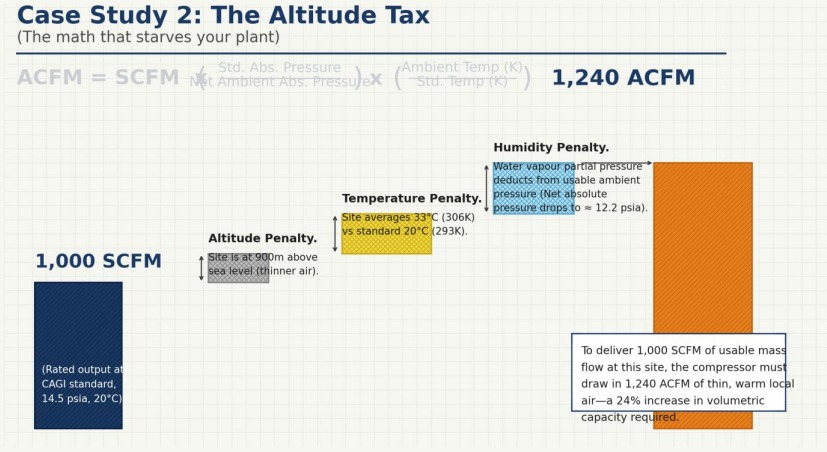
Figure — The Altitude Tax: how altitude, temperature and humidity penalties stack up to turn a 1000 SCFM requirement into a 1,240 ACFM intake demand.
Key Takeaways
- A machine's stated air requirement is a mass requirement, expressed as an equivalent free-air volume — not a statement of actual volumetric flow.
- Pressure tells you the energy level of the air; flow tells you the rate at which air mass must be supplied to sustain that energy level.
- Free air consumption of individual components is directly additive, which is why every compressed air calculation converts everything back to free air.
- A screw compressor captures a fixed geometric volume every revolution (Swept Volume); pressure is created inside the machine, not drawn in from outside.
- Volumetric efficiency — not swept volume — is what falls as discharge pressure rises, because internal leakage increases with pressure differential.
- Internal Compression Ratio (Vi) must match the intended operating pressure, or the compressor suffers over- or under-compression and wastes energy.
- Roughly 90–95% of a compressor's electrical input ultimately becomes heat — making heat recovery one of the most under-used efficiency opportunities in a plant.
- Every 1 bar of unnecessary discharge pressure typically costs about 6–8% in extra compressor power.
- Specific power (kW per unit of FAD), not FAD alone, is the correct basis for comparing compressors.
- The atmosphere — its pressure, temperature and humidity — determines how many air molecules a compressor can capture, before the rotors ever begin to turn.
- ACFM = SCFM × (Standard Absolute Pressure ÷ Net Ambient Absolute Pressure) × (Ambient Temperature ÷ Standard Temperature) — the exact bridge between a fixed process requirement and the actual volume a compressor must ingest at site.
- Altitude, heat and humidity stack together: a real site can demand 25–30% more actual intake volume than the standard-condition nameplate figure suggests.
- The air intake system is the compressor's lungs: a restricted or hot intake reduces mass flow, wastes energy, and shortens airend life.
- The airend, not the motor, is the true efficiency engine of a rotary screw compressor — rotor profile, clearances and Vi determine FAD and specific power far more than motor selection does.
From Atmosphere to Actuator
This article traced a single molecule of air from the atmosphere — through a cylinder's demand, into a compressor's airend, through thermodynamics, internal compression ratio, and back out as usable energy. The message is consistent: understanding what a machine actually needs (mass of air at pressure) and what a compressor actually delivers (volumetric displacement, corrected for real site conditions) is the foundation of every correct sizing decision.
At Advanced Equipment & Solutions Pvt. Ltd., every KAESER compressor selection we prepare starts with the same three questions: How high? How hot? How humid? Because the atmosphere decides how much mass enters — and we make sure the compressor we specify can deliver it.
Need help sizing your compressor for real site conditions?
Our team offers:
- Site-specific compressor sizing with altitude, temperature & humidity correction
- SCFM to ACFM conversion for your exact location
- KAESER compressor selection using SIGMA AIR MANAGER
- Compressed air system audits & energy assessments
- Piping design & pressure drop analysis
- Heat recovery feasibility studies